
Address Text (Original document available below):
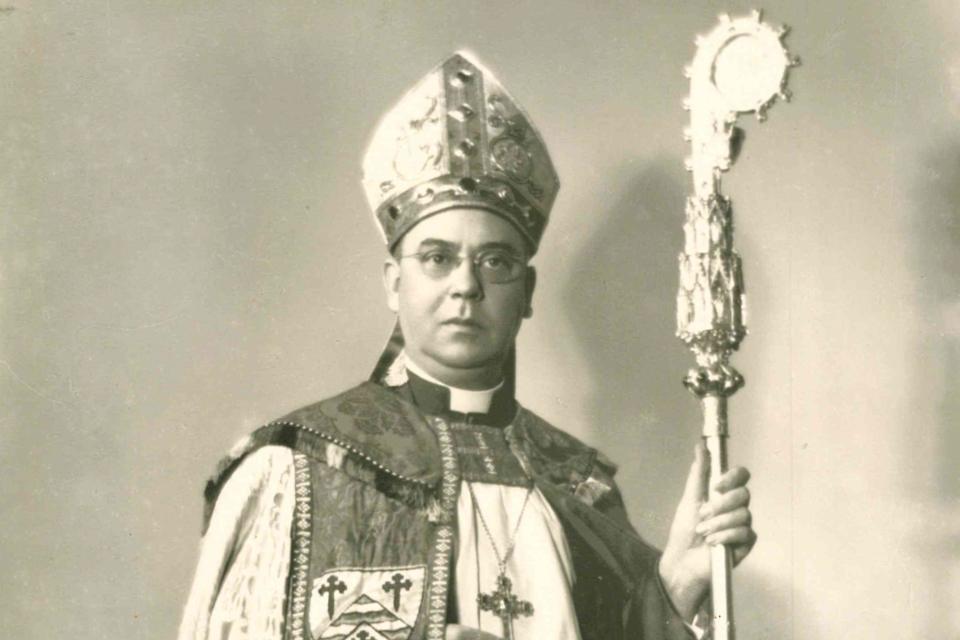
Convention Address by the Bishop of the Diocese The Rt. Rev. James P. DeWolfe, D.D. May 19, 1942
A Challenge to Serve
Brethren of the Clergy and Laity: Grace to you and peace from God our Father and the Lord Jesus Christ. We give thanks to God that He has called us to this honored and responsible ministry in His Church. The office of a Bishop is, to be a chief pastor in the Church —"a chief pastor in the Church"—not "over" or "for," but "in." A bishop's prerogative, therefore, is to excel in Christian virtue: in his obedience to the heavenly vision, in his administration of justice, in his persevering dispensation of love.
It is an encouragement to him to realize that he but shares the obligation of Christian virtue with the whole Church. That the further obligation to excel in Christian virtue is laid upon him is his incentive to rely more and more dependently upon the love of God, and the grace of the Lord Jesus Christ, and the communion of the Holy Spirit. To this end I bid your daily praying on my behalf, that I may reflect in my ministry in this Diocese the glorious qualities of the Good Shepherd himself, whose joy it was, and still is, to be "in the midst of you as he that serveth." This seventy-fifth Annual Convention...
[Note: Content Missing — Original Pages 4 and 5 are missing from the text document.]
...lism that the Presiding Bishop calls us in the Forward in Service program. The concern of the Church, therefore, is to apply in the world, in all human relationships, the Doctrine of God in all its implications; so will His Kingdom be realized by, and actualized among men.
In reference to the realization of the Kingdom of God among men, there are two notes I wish to strike emphatically, if briefly. The first is that the achievement of such a social structure among men as could be truly claimed to reflect the organization which is IN God, is NOT THE WORK OF EXPERTS in the field of sociology or religion. If the kingdoms of this world are to become the Kingdom of Christ, Christianity must be lived consciously and perseveringly by every single clergyman, every single layman and laywoman, every single young person of whatever age constitutes youth, who loves JESUS CHRIST and rejoices to bear His Name. The Church as The Church must perform to bring this mighty thing to pass. No Committee, indeed no Commission, is equal to the necessity. It is God working through His Church—His very Body—which will make this a reality.
The second observation has to do with current wide-spread practice, which, were it to be defined, might aptly be described as "Works without Faith." The Church too frequently is counted as one among many philanthropic societies working for the relief of human suffering and the bettering of social conditions. The consciousness that it is GOD's Kingdom that is to be applied seems to be lacking, and its place is a measure of reserved faith in the innate capacity of human nature to work out its own problems. Much so-called "Church work" resolves itself into the doing of good for the sake of doing good, without the slightest conscious reference to Christ, His Church, His Kingdom. I dare not say what the net result of de-Christianized "good works" might be eventually, but I have no doubt whatever that the Kingdom of God will elude capture by such measures. If faith in Christ without works is dead, we may be assured that works without faith in Christ are equally lifeless. The thirteenth of the famous Thirty-Nine Articles deserves devout reflection—which we might accord it, without thereby deserving the charge of reactionary narrow-mindedness.
The Forward in Service Program, outlined in the Presiding Bishop's Ten Year Plan has these two objectives, among others, in mind. It seeks to bring every one of Christ's men and women and young folk into active participation in the prosecution of the Church's glorious and God-given Mission. It seeks to establish and deepen in the minds and wills of all Churchmen, and through them to establish and deepen in the minds and wills of all men everywhere, the conviction that JESUS CHRIST alone is the Light of the world, the only Saviour, the one Hope, the sole Redeemer of mankind. Because the Plan is so rightly conceived, so rightly based, so wisely pointed, there can be no question that in this Diocese the Forward in Service Program will serve as the impetus to our deeper consecration in being the Church and in renewing our zeal and passion to work and pray and give for the spreading of His Kingdom.
The prayers of Kagawa to "establish thy Kingdom O God, beginning with me" is a real Christian missionary program. This same principle can be applied to every parish of this Diocese. A parish that is actively missionary within its own boundaries will add strength to the missionary purpose and motive of the Diocese. A Diocese that is determined to carry out a Diocesan Missionary Program with intelligence and self-sacrifice will add strength to the Mission of the Church throughout the world.
It is evident to every member of this Convention that our Missionary opportunity in this Diocese is outstanding. We are one of the fastest growing Dioceses in the Church. We shall maintain that position only as we are able to see our opportunities. This Convention must be aware of this fact that an opportunity under God, is a responsibility under God. In view of this, I am presenting the following Diocesan program for our Missionary work, through the Council, and I am presenting it now to this Convention:
First, it is taken for granted by your Bishop that a great and outstanding work has been done through the Archdeaconries. However, after a careful survey of the Missionary needs and opportunities of this Diocese, I feel that more of a Diocesan program should be developed where all of the Archdeaconries represented will consider the Diocesan scope of our Missionary program. This will mean that the Missionary activities of the whole Diocese will be considered by a central department, in place of being considered separately by an executive board in the Archdeaconry. Such a department we already have in the Council, known as the Department of Missions. Your Bishop needs an intimate relationship with the work in the field and to that end, the Department of Missions and Church Extension will have frequent meetings to consider the whole Missionary enterprise in this Diocese. Here the Bishop of the Diocese, the Suffragan Bishop, the Archdeacons, together with lay representatives from the Woman's Auxiliary will consider our whole Diocesan Missionary opportunity and responsibility. This Planning Board will be Diocesan and not local in its outlook. We shall have one Missionary budget for the whole Diocese and, as the Diocese Planning Board, be able to bring the resources of this budget to bear on those situations we feel need the wholehearted support of the Diocese.
The second step in this program has to do with the Diocesan Convention assuming the full responsibility of Missionary work. To bring that about, it will be necessary that the Missionary budget of the Diocese be presented to the Convention each year and passed on by the Convention. It will include, of course, our budget for the Missionary work in the Diocese, as well as our pledge to the National Council. This will have two results: first, it will bring the scope of our Diocesan Missionary work before the Convention each year and will be a means of education; second, it will give authority to the Clergy to go back into their parishes and, with the authority of the Diocesan Convention, to raise necessary funds for the pursuance of the program.
The third step in this program is to relieve Bishop Larned from his active work as an Archdeacon in Brooklyn and Suffolk so that he may be able to assist the Bishop in the general missionary work of the Diocese as outlined in this address. Since Bishop Larned will give his full time to the whole Missionary activity of the Diocese, the Archdeaconries of Brooklyn and Suffolk will be asked to nominate to the Bishop active parish priests to supervise local work. The men who are elected the Archdeacons will work directly under the Bishop in carrying on the activity of the Archdeaconry. Such men will be informed as to their own regional opportunities. They will be in constant association with our Diocesan Department of Missions, and thus be able to direct our work to our common advantage. It is our hope that such parish priests will be able to serve without salary, although we must expect to underwrite needful expenses.
The last step in this program will be to consider a few minor changes in our present Canons, but I am certain such changes will be approved at our next Convention.
The hopes and plans that have been outlined to you this day have received the hearty approval of your Diocesan Council and others associated with the present administration of Missions in this Diocese. United action is so necessary in the Church and in the Diocese. To this end our program will follow closely the Forward in Service Program of the National Church. I am asking all groups in the Diocese, clergy and laity and young people, to respond to the Diocesan-wide Forward in Service Program. It is well for us to remember that each year the National Commission on Forward in Service is setting up a new objective. The objective for the first year was to present to the Church the need of worship and prayers. However in the end of the first year we are not to give up worship and prayer, but continue it and take up a new objective, which, this year is Evangelism.
In order that I may think clearly and act definitely about this program in Long Island, I have set up four major activities toward the strengthening of the Evangelical program throughout the Diocese. Four aspects of the Forward in Service Program during the year are: first, Evangelical preaching; second, preaching missions; third, human relations; and fourth, help to the life of devotion. At a meeting held with the Clergy in Garden City some ten days ago, Committees under such headings were appointed to survey the needs of the Diocese in those fields and to draw up a plan of action which will serve as the...
[Note: Content Missing — Original Pages 12 and 13 are missing from the text document.]
...life of the Church. We are out to convert. To this end, every Churchman need be diligent that the uninformed be brought to hear the preaching and to receive the teaching. What I am saying to the newly confirmed, I say to all: Church School teachers, members of the Woman's Auxiliary, Wardens and Vestrymen of parishes, Executive Committee members of Missions, Guild Members of all and every Guild—be out to convert, to bring some others to Baptism and Confirmation, to Church Service, to the Mission when it is held in your own locality. Release your pastor from many of the details of parish life that he may give himself to study and sermon preparation. You gather together those who in the foreign mission field often are called "hearers," and trust your pastor to commend to them fruitfully, the Lord Jesus and His Church.
Teaching Missions are invaluable if they teach; if they serve mainly as an excuse for the lusty singing of the dozen or so "well-known" hymns to which no one seems allergic, their worth is almost negligible. Teaching Missions are invaluable if they teach. And what a Gospel the Church has to teach! The Gospel of the Incarnation is the glorious burden of the Church's preaching and teaching which alone can satisfy a world at war with itself.
That majestic passage of the Nicene Creed which assures us that Jesus Christ, the only-begotten Son of God, begotten of his Father before all worlds, God of God, Light of Light, Very God of Very God; being of one substance with the Father; by whom all things were made: who for us men, and for our salvation came down from heaven, And was incarnate by the Holy Ghost of the Virgin Mary, and was MADE MAN: has been cited as poetry, sometimes by the very men whose commission it is to be the voice of the King himself. Whether it be poetry or not, it is the Christian Creed, upon whose truth the Church stands or falls. JESUS is GOD come in the flesh, or you and I are imposters. We have solemnly promised GOD and our fellow-men to believe all the articles of the Christian Faith, and to uphold that Faith as it is enshrined in the Book of Common Prayer. We must be found faithful.
Teaching Missions properly are popular schools of theology. They provide excellent opportunity for investigation and review of the Church's own true being and nature. I shall hope that in the diocesan-wide Teaching Mission to be held some time during the year, a clear presentation of the Church as the Mystical Body of Christ may be so made everywhere that the sense of the corporate unity of the Church in the Diocese may be enhanced. Our people everywhere need to be informed of the capacities of the Church, and the great helps that God has to meet every need of the individual and society by word and by Sacrament. But, however adroitly the sacramental principle may be commended by means of Teaching Missions, or Evangelical Preaching, both preaching and teaching are sterile until action ensue.
Human relations, therefore, constitute a vitally important third phase of the Forward in Service agenda proposed for our consideration during the year. What I have been saying throughout this address in regard to the Kingdom has already intimated to you in general my mind as to what bearing the Church must have upon the ordering of human society. She has the whole of Almighty GOD Himself to impel her, in these days of social upheaval, to witness to the worth, the sacredness, of human personality. As perhaps never before in history she has the chance to demonstrate that the Christian religion, and the Christian religion alone, has the power to rehabilitate personality.
Unless the Church is able to walk among the poor and needy, the oppressed and the under-privileged of this world as our Lord walked through the streets of Galilee, among the harlots, the pharisees, and the poor and the working men, it will fail in its Christian mission. "There is neither Jew nor Greek, there is neither bond nor free; for ye are all one in Christ Jesus." If it fails to witness to the one who came about doing good to all sorts and condition of people, it will betray its God-given Mission and slump down into unsullied respectability and to be beguiled with purple and fair linen. We must arouse ourselves from the self-contentedness which has so often possessed the Church—that self-contentedness which let others do it, which left interest in God's children to trade unionism and State's legislation and performance. The Church must suffer and give for the Children of God everywhere, if she is to bear effective witness to the suffering Christ.
This brings me to a brief consideration of our own Church Charity Foundation of Long Island. The Church Charity Foundation represents one of the great achievements of this Diocese, comprising as it does provision for the care of all kinds of human dependency. It is truly a part of our Missionary work and is a fine example of the Church's work for the solution or alleviation of human problems. Now we must bring our resources to bear to enable the Church Charity Foundation to maintain its standards and continue its services unhampered. From my investigation I feel that it is worth while for the communicants of the Diocese to make an annual contribution to the fund and to subscribe to its Sustaining Fund and participate in the Canonical offering.
The Foundation anticipates a deficit of at least $50,000 for the current year and there is no immediate prospect of improvement in the investment picture at least for the present. The deficit itself represents a small item in comparison with the vast resources of the people of the Church in this Diocese. In a recent letter from Bishop Stires, he has written to me: "You will forgive me for asking that you will give generous thought to the work and needs of St. John's Hospital. Its work should inspire our deepest gratitude and pride. Its needs are urgent and can be met only by the sacrificial offerings of our people." By recognizing the important value of the Church Charity Foundation, by participating in its financial promotion, by sharing in its resources, we can, as a Diocese, not only hold the present excellence of the Church Charity Foundation, but we can also help it to continue extending its services in the areas of need which are met by no other agency in the Diocese.
I trust that the Committee on Human Relations, in its report to me on May 22nd, will include a recommendation that the Clergy and the laity of the Diocese devote at least part of their reading and study and discussions during the coming year to the subject of Christian sociology. A helpful manual for that purpose will be found in Cyril Hudson's short and readable "Preface to a Christian Sociology." Moreover, there is work to be done in the social field right here on Long Island, quite in addition to that of the Church Charity Foundation and other existing institutional commitments, it should receive not only our attention but our ministry. Our Department of Social Service anticipates an active program in the field of human relationship. I urge your cooperation to assist them in their endeavors.
The Diocese is called upon in particular to support adequately the work of the Army and Navy Commission; to provide spiritual ministrations to the many hospitals on the Island that at present are without the services of chaplains; and to strengthen the somewhat feeble beginnings of the week-day religious instruction of our youth.
The fourth emphasis is that of deepening the devotional life. Being is actually more essential than doing, for doing will depend in the long run upon what we are. By means of Retreats and Quiet Days, and by the exercise of the discipline entailed in ordering our interior life of prayer and self-giving by the standard of a daily rule, both clergy and laity alike are enkindled with the fire of the love of God. As the founder of the Society of St. John the Evangelist once observed, we are not so much called to do great things for God, as to have God do great things in us. If I say no more under this heading, you will understand that it is because I expect such mutual agreement to exist among us—agreement upon the principle that personal devotion is the rock upon which is founded all that we can become and do as the Church: so that we shall readily give priority to the claims upon our time and attention which may be made by arranged periods of meditation and recollection.
May we start out together hand-in-hand—Bishop, Clergy and people, with mutual love, respect and Christian courtesy to accomplish the work of the Kingdom.