
Sermon Text (Original document available below):
Whom Then Shall I Fear?
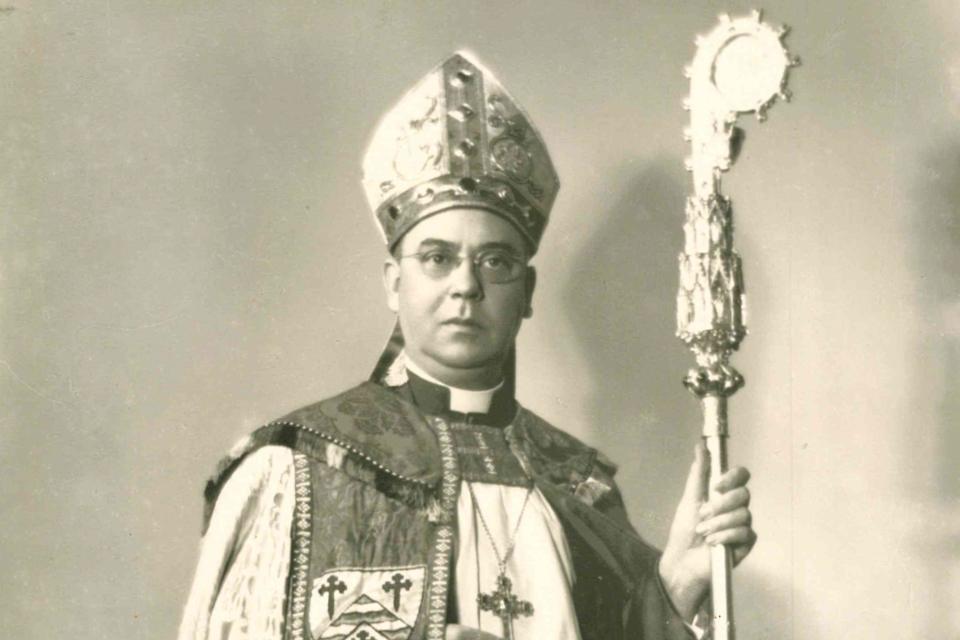
Sermon by The Very Reverend James P. DeWolfe, S.T.D.
Dean of the Cathedral of St. John the Divine
Broadcast over the Columbia Network on "The Church of the Air"
Sunday, December 28, 1941
The patience and the faith of the Saints is profoundly expressed in this simple question "The Lord is my light and my salvation; whom then shall I fear?" The great strength of religion is that it is designed by God to take men as safely through the Valley of the Shadow as through the comforts and conveniences of life. In spite of the criticism leveled at religion by the self-sufficient people of the lush days, the Church quietly continues to shepherd men into the fields of reality.
Our civilization has been exposed to various human essays in defining reality and our souls, our minds and our bodies have all suffered from these vain conceits. In the recent day, when it was popular to excuse all forms of brutality and ugliness as realistic literature or art, the blasé and coldly selfish children of this world forgot one simple fact, that the same Man who knew the "reality" of desertion, betrayal and a Cross also knew the reality of the lilies of the field and the birds of the air. Beauty is just as real as ugliness; and holiness, as sin. Only a religious man can know that the only reality—the only eternally abiding thing in the universe—is God, and knowing this, neither persecution, war, nor death is to be feared.
Thus, over against the background of the world today we see the reality of Almighty God. I venture to say that many who have lived carelessly, many who have thought little about the cultivation of the attributes of the spirit have in the last four weeks known, possibly for the first time, a yearning for the infinite God, His beauty and His peace. Over against the darkness of a benighted world men long again to see the star which heralded the coming of the Light of Life. To the thoughtless it may seem a mockery that the Holy Church should, day after day, bless her people with the "peace of God". The Church, however, is ancient and wise, and knows that the peace of God is an inner serenity given by Him to all who come in penitence and prayer. War is a transitory thing, a passing phase of this sorry world, but forever, yes for eternity, God's peace abides—nothing can obliterate that.
In the Gospel according to St. John, we see the calm, unhurried operation of the mind of God. In the midst of the turmoil and disaster of an ancient world, the history of the early Church is studded with the glorious lives of Saints and Confessors who fearlessly and patiently suffered for the truth's sake. The horrors of the Colosseum, fire and rack never succeeded in robbing Christian souls of the peace of God. St. Louis knew peace in the midst of an onerous infidel prison. Nurse Edith Cavell and Pastor Niemoeller, in our own day, witness the timeless serenity of the righteous and believing.
Right now, some place on the battlefield, there is a dying soldier lifting up his prepared hands to receive the Bread of Life, and I assure you that resting upon that dying man is the peace of God which passeth understanding. The religious man fears none but God and therefore knows God's peace.
The peace of God, however, is not a way of escaping the troubles of this world; it is a method—the only method—of facing them. The man who knows the peace of God also knows the love of God. Over against the background of hate which is certainly rife in this world today is this amazing mystery of the love of God. That cry from the Mount of Sermon, that cry which pierces our hearts, which has always struck human beings where they live, is "Love your enemies, pray for them which despitefully use you". Oh yes, we are to hate things; as Christians we have no part with those sentimentalists who would have us hate nothing. We are to hate sin, we are cultivated to hate it. The Church educates our conscience so that we may immediately sense its presence; we are taught to despise anything that chains or imprisons human personality. One does not truly read our Lord's life who misses the cold and deadly anger he showed at every sign of contagious and perversive sin—His flat statement about those who pervert youth is terrible to read when one realizes that it is uttered by God Incarnate. "But whoso shall offend one of these little ones which believe in me, it were better for him that a millstone were hanged about his neck, and that he were drowned in the depth of the sea!"
We hate these things because we love God, and because we love Him, we must love His divine image, wherever it may be found or whoever may possess it. As our brothers' keepers, we preserve even for our enemies (and in spite of our enemies) the pure message of the immortal value of a human soul. We may hate the methods of a person, we may despise his philosophy, we may fight against it with all that is in us, but never as Christians can we be victors if we permit hatred to penetrate the centre of our nature where love should be. Over against the hatred of the world the Christian knows and believes in the eternal love of God.
Over against the war and brutality of the world and its confusion, stands the peace of God. Over against the fear of the world is the Christian experience that in quietness and in confidence shall be our strength. The noise of the world, the propaganda of the world, the stupidity of the world, will, if we permit, make us wanderers in place of pilgrims. The Christian need never be like that, for two thousand years of Christianity have shown us the patience and faith of the Saints.
Our President has called this entire nation to prayer. On New Year's Day we are to join in solemn supplication on behalf of our country—begging God to forgive our manifold transgressions and violations of His trust, asking for the strength and courage to prosecute with dignity and faith the difficult task that lies before us. The generosity of Americans is great—no call of human suffering falls on deaf ears. The American warmness of heart is quick to resent injustice and human degradation. Too often, however, we give from habit and feel resentment only when our own kind are menaced. Surely by now we should have learned that in the Infinite wisdom of God this country has become the homeland of all "kinds"—men from every race and creed—who dwell in unity. Our country has been built on the practical application of the principles of religion, and only by turning to our fathers' God can we hope to grow and build with their success.
Do not be deceived, we need to repent! As stewards of the greatest treasure-house on earth, blessed with freedom of worship and freedom of endeavor, we have wasted our substance in riotous living and petty internal bickering; we have been careless of our right to worship God and heedless of the other person's right to earn a living. This great nation has within the memory of each of you seen the menace of class hatred, race hatred, and religious bigotry all the result of sinful human fear! We need to repent!
And let us not be deluded by the wealth and ability of our good land. We are in a mortal struggle for the maintenance of our way of life. For years it has been popular to fancy that no enemy would dare attack us. "Peace, peace" we have cried, and there was no peace of God and therefore no real peace of man. We need the help of Almighty God as we have never needed it before and we need it in every department of daily life as well as on the field of battle. God is our hope and strength, and believe me we have no other.
The great Charles Kingsley had some words singularly appropriate:
The day of the Lord is at hand, at hand,
The storms roll up the sky;
A nation sleeps starving on heaps of gold,
All dreamers toss and sigh.
When the pain is sorest, the child is born,
And the day is darkest before the morn
Of the day of the Lord at hand.
Gather you, gather you, hounds of hell,—
Famine, and Plague, and War;
Idleness, Bigotry, Cant, and Misrule,
Gather, and fall in the snare!
Hirelings and Mammonites, Pedants and Knaves,
Crawl to the battle, or sneak to your graves,
In the day of the Lord at hand.
Who would sit down and whine for a lost Age of Gold
While the Lord of all ages is here?
True hearts will leap up at the trumpet of God,
And those who can suffer can dare.
Each past Age of Gold was an iron age too,
And the meekest of saints may find stern work to do
In the day of the Lord at hand.
Are you willing to cultivate a spiritual sensitivity which will make it possible for you to be aware of the presence of the God of Love, of Peace, of understanding and strength? Are you willing to see things through to the extent that your prayer life will be daily instead of weekly? Will you, in the midst of confusion, in the midst of hardship, in the midst of sacrifice, seek God before His Altar and in the quiet corners of His temple, with faith and confidence regularly, daily, by prayer, by Communion, by meditation?
This is the Christian way of life against the background of a naughty, warlike, tyrannous, sinful and dark world. This is the Christian patriot's way of offering his country to God that we may be found a people acceptable in His sight.
I should utterly have fainted, but that I believe verily to see the goodness of the Lord in the land of the living. O tarry thou the Lord's leisure; be strong, and He shall comfort thine heart; and put thou thy trust in the Lord.