
Written by: the Rev. Cn. Adam Bucko, Sub-Dean of the Cathedral of the Incarnation and Co-Founder / Director of the Center for Spiritual Imagination
I had an uneasy night and woke up early this morning. Not from a comfortable sleep where you wake rested, but from a bothered, disturbed sleep. I woke up and spent about thirty minutes just breathing, just coming back to myself, to my heart, holding my heart.
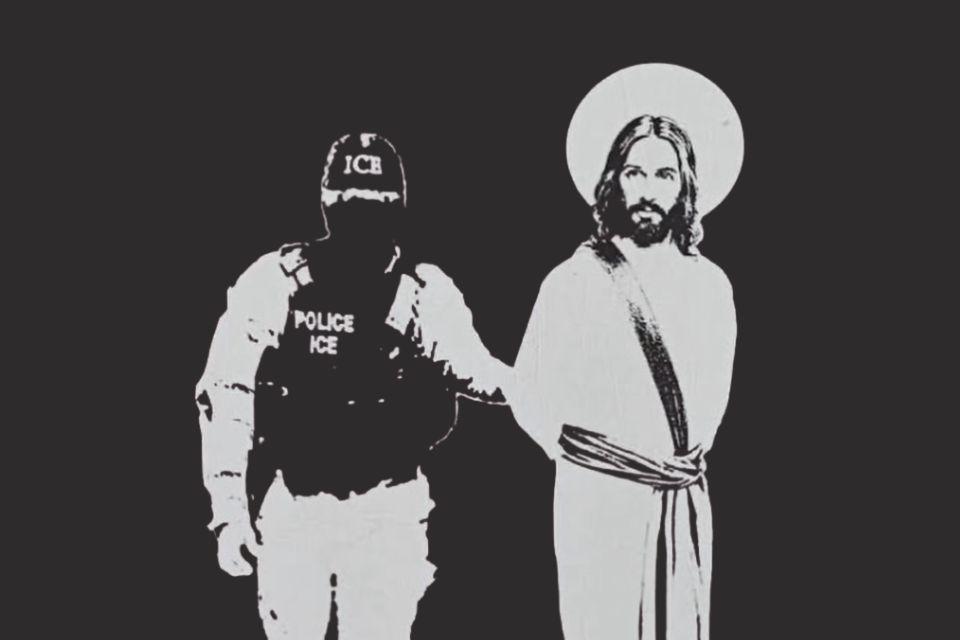
I couldn’t sleep because of what had happened yesterday: a protestor shot and killed on the streets of Minneapolis by federal agents, after he was beaten to the ground and pepper-sprayed. Frame-by-frame analysis of several videos now available makes it clear that the official story presented by the government, painting him as a threat intent on maximum damage, is simply fictional.
Having watched the video as I struggled to understand, and then struggling through the night, I couldn’t help but feel as if I were back in Eastern Europe in the 1980s, back behind the Iron Curtain, where borders were sealed, fear was the air people breathed, violence enforced obedience, and truth itself was a threat.
This is not abstract for me. I feel it in my body.
All of a sudden, I am a child again, frightened by tanks occupying our streets.
I am a child again, learning that Fr. Stanislaw Suchowolec, a parish priest I attended Mass with just days before, had been killed by the government.
I am a child again, seeing images of the tortured body of another priest, Fr. Jerzy Popieluszko, kidnapped, beaten, and thrown into a river, broadcast on national television.
Both priests, and many others, were portrayed as terrorists intent on doing maximum damage to the country. But we knew better.
We knew who was doing the damage.
They were killed because they saw what was happening and refused to be quiet—because they were not afraid to preach fearlessly, standing with the victims of injustice while calling those who serve lies back to conscience, back to truth, back to freedom, back to that still point deep inside where we are always held by God, who is loving us into courage and giving us strength to say no to everything that violates the dignity God has breathed into every life.
They were killed because they saw clearly and did something about it.
They saw mass arrests and the imprisonment of workers, students, and organizers, often without real charges. They saw internment camps and overcrowded prisons used to crush dissent. They saw the secret police operating with total impunity, surveilling, threatening, beating, and killing without accountability. They saw deaths in custody explained away as accidents or suicides. They saw paramilitary police unleashed on civilians in the name of “order.” They saw informants everywhere, turning neighbors against one another. They saw fear used deliberately as a governing tool. They saw truth replaced by propaganda, repeated until lies sounded normal. And they saw how life inside institutions adjusted to this reality, as many people learned to live with lies, adapting just enough to survive or to benefit, careful not to disturb the arrangements that allowed their lives to continue without much interruption.
They saw all that, and from the pulpit, they said no.
They said violence does not become just because it is legal.
They said fear enforced by law is not peace.
They said silence in the face of injustice serves power, not God.
And they knew what that would cost.
We are seeing similar things today.
We are seeing armed federal agents operating with little accountability. We are seeing detention and deportation systems where people disappear from public view. We are seeing deaths during arrests and in custody minimized, reframed, or quickly forgotten. We are seeing incarceration and detention used to intimidate not just individuals, but entire communities. We are seeing fear used deliberately as a governing tool. We are seeing cruelty justified as enforcement.
Just like then, we are told this is necessary.
Just like then, we are told to look away.
Just like then, silence is called neutrality.
It isn’t.
This is why contemplative prayer matters, but only when we understand it rightly.
Contemplation is not a spiritual vacation, not a way to numb ourselves or escape the world. We do not pray to get away from our lives. We pray in them, in our fear, our grief, our anger, our confusion, and we bring all of it into stillness.
To sit in contemplation is to open ourselves to the Living Presence at the heart of everything, a quiet but insistent movement toward wholeness, toward justice, toward communion. This movement is not automatic. It longs to live through human bodies, human choices, human courage. It needs consent. And contemplation is where that consent is learned.
That presence does not anesthetize us. It sharpens our sight. It breaks through denial. It refuses to let us make peace with what dehumanizes.
Real contemplation clarifies rather than comforts. It trains us to see violence without becoming violent, to face lies without becoming cynical, to stay tender in the presence of suffering. It is subversive because it will not allow us to privatize our spirituality or turn prayer into a commodity for personal well-being. This is why real contemplation is dangerous.
And still, it is not sufficient.
Many stop here, assuming that clarity of heart will somehow produce change. It rarely does, because moral clarity alone does not dismantle systems built to outlast conscience.
Those priests I remember from my childhood understood this intuitively. They prayed. And I think they sensed that both prayer and action cannot be abstract or theoretical, that both must become presence among those being brutalized: workers on strike, families of the imprisoned.
They became part of extended families, assisting households broken by violence, rather than standing at a distance and analyzing suffering in the abstract.
They also understood that social change does not come from lone moral heroes, but from communities and movements acting together over time. From that shared life—from proximity and responsibility—they learned how change actually happens. That is why they organized, why they embedded their courage in shared social analysis of how power operates and in collective discipline, and why their witness carried weight.
This is how contemplation enters history—not as private virtue, but as part of a shared ecology of action.
This reflection was originally published as an entry in Contemplative Witness by the Rev. Canon Adam Bucko. Contemplative Witness is a space Bucko shares personal reflections, sermons, articles, journal entries, and conversations with friends—activists, spiritual leaders, or simply companions on the journey of engaged spirituality. You can subscribe to the Contemplative Witness by clicking here.